
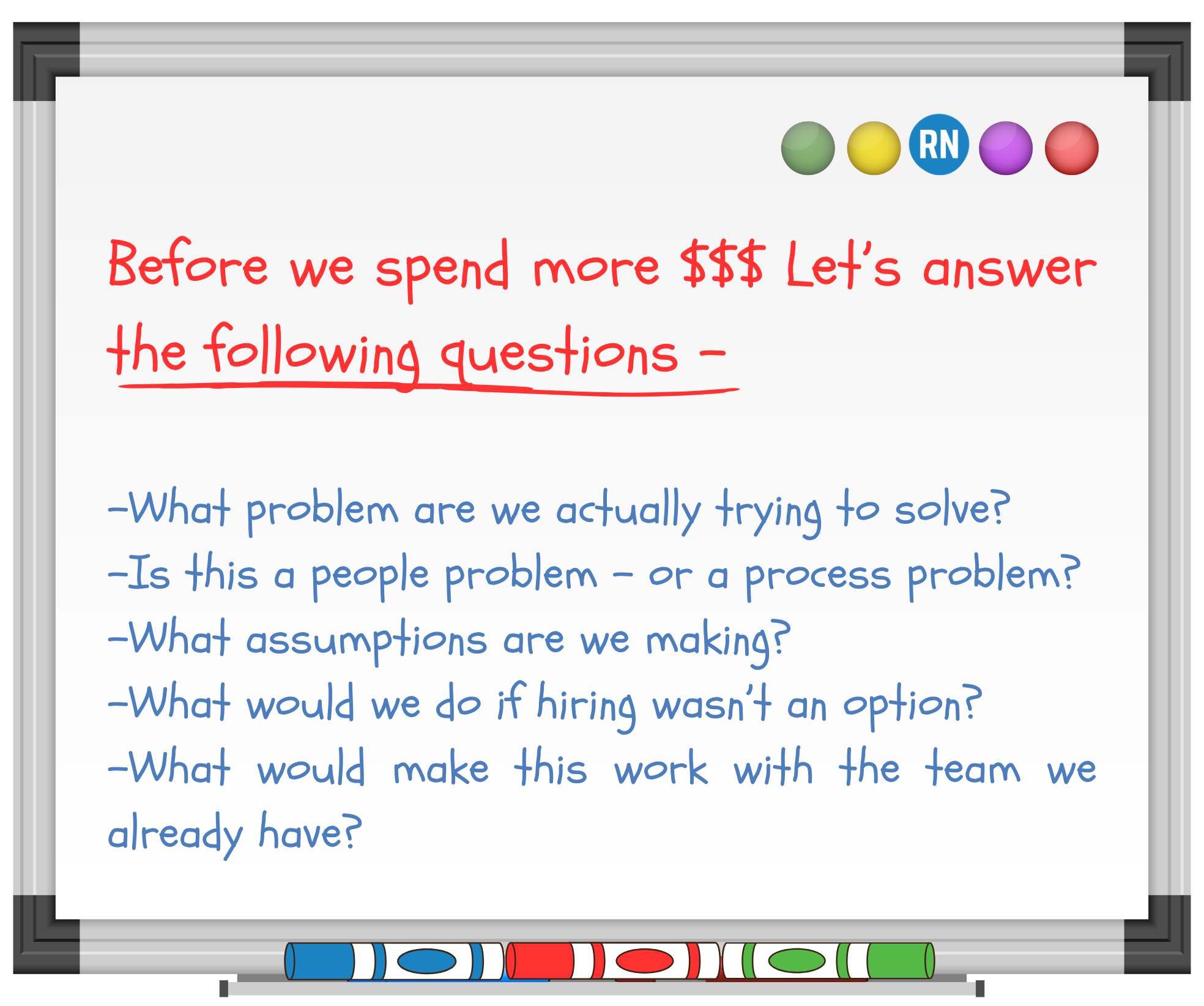
One of the questions I like to ask leadership teams is this:
If adding people or spending money wasn't an option, how would you solve this problem?
It's interesting how the conversation changes.
Too often, our first response to a business challenge is to add resources. Sales are growing? Hire more people. Production is behind? Add overtime. Customer service is overloaded? Increase headcount. We are convinced that the solution lies somewhere in the next budget request.
Sometimes it does, but many times, it actually doesn't.
I've experienced that some of the best improvements are created when we temporarily remove people and capital from the list of potential solutions. When we do this the discussion really changes.
Instead of asking who or what we can add, we can begin by asking better questions.
Can we simplify the process?
Can we eliminate unnecessary steps?
Are responsibilities clear?
Is information reaching the right people at the right time?
What is creating the rework?
What system is allowing this problem to happen repeatedly?
Constraints have a way of forcing us to be more creative in our approach.
I've watched teams uncover inefficiencies that had existed for years because they were challenged to solve the problem without hiring another employee or buying another piece of equipment or software. They discovered that the issue wasn't capacity, it was communication, process design, decision-making, or unclear expectations.
Once those issues were fixed, they often realized they had more capacity than they thought.
This doesn't mean businesses should not invest in people or technology. Smart organizations invest continuously.
The difference is the timing.
The best investments come after you've improved the system, not before.
Adding people to a broken process puts more people operating inside a broken process.
Adding technology to poor discipline often automates inconsistency.
Capital should improve a well-designed system, not compensate for one that isn't working.
As leaders, we should occasionally challenge ourselves with a simple exercise.
For the next problem your team faces, ask this question:
Assume we can't spend another dollar or hire another person. What would we do?
You may still decide that additional investment is the right answer to the problem.
But you'll reach that conclusion after exhausting the one resource that often delivers the highest return:
Creative thinking.
Sometimes best investment isn't additional capital. It's better thinking.
